
© Eric R. Pianka Physics and chemistry have given us two basic laws of thermodynamics that must be obeyed by all forms of matter and energy, including living organisms. Despite our cleverness and power, humans are not exempt from these laws. The first law of thermodynamics is conservation of matter and energy: matter and energy cannot be created or destroyed, but may be transformed. Perpetual motion machines are impossible. The second law is that disorder always increases. Over time, randomness increases as matter disperses. Fossil fuels (coal, oil, and natural gas) were formed hundreds of millions of years ago by primary producers long before there were any people. During the last century, humans have burned up vast amounts of these limited supplies of fossilized sunlight. We must stop squandering Earth's non-renewable resources because burning fossil fuels releases carbon dioxide into the atmosphere which in turn increases its heat-holding greenhouse effect and leads to global warming. Moreover, fossil fuels are a finite resource and we are rapidly running out of them. As human populations burgeon and economies grow, demand for limited supplies has driven up the price of oil. Although some fools delude themselves into thinking that oil replenishes itself deep in the Earth, it does not. Unfortunately, humans have become very dependent upon fossil fuels because they are portable, concentrated, and easily stored and transported. Other energy sources, such as sun, wind, and electricity are not nearly as versatile. Some pseudo-scientists under the payroll of big oil assert that oil supplies are adequate to get us through to the end of 2100, but no one knows how long dwindling supplies will last in the face of rapidly increasing world wide demand. Also, the future impact of global warming is coming up on us very fast. Burning of fossil fuels has released large amounts of carbon dioxide levels into Earth's atmosphere. By reflecting heat back to the planet that would otherwise radiate out into space, greenhouse gases such as CO2 and methane have warmed the Earth's land surface and oceans (see global warming). We must stop adding greenhouse gases to the atmosphere to slow global warming. 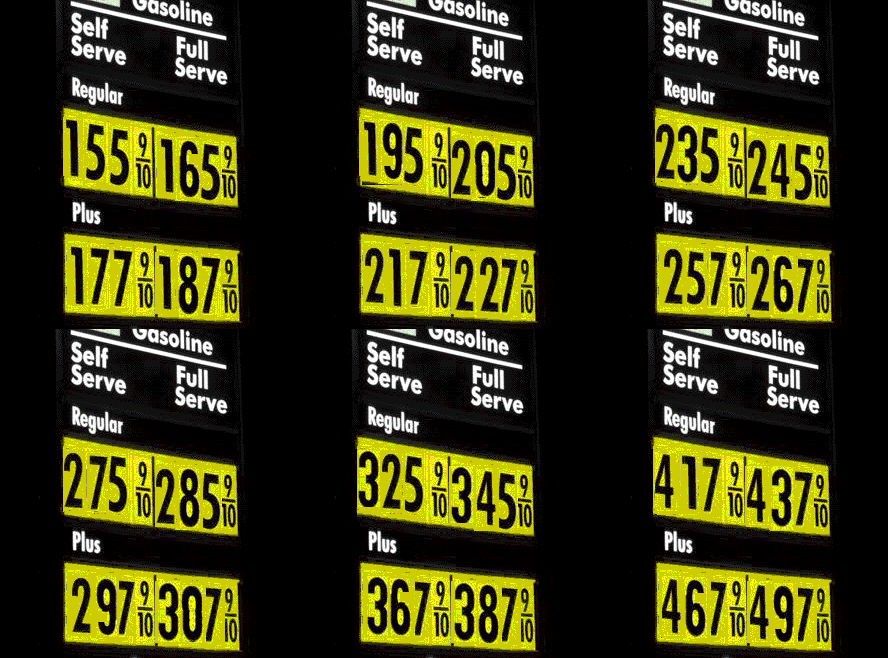 Americans are now suffering from painful increases in the cost of
gasoline at the pumps with no end in sight. People are clamouring for
alternative new sources of energy. Many seem to think that we don't have
to obey laws of thermodynamics. Using energy always produces heat, and
unless it can be dissipated, temperatures must rise.
Americans are now suffering from painful increases in the cost of
gasoline at the pumps with no end in sight. People are clamouring for
alternative new sources of energy. Many seem to think that we don't have
to obey laws of thermodynamics. Using energy always produces heat, and
unless it can be dissipated, temperatures must rise.
 Because people have electrical outlets all over their houses and
offices, they suffer from the illusion that electricity is clean energy,
infinite in supply and will always be there. None of these
assumptions is true -- unless we convert to an electrical system based on
renewable resources such as solar energy, power grids must ultimately fail
and the internet will cease to be. Whenever you turn on a light or an air
conditioner, chances are that fossil fuel is being burned to generate
the electricity you're using. A relatively small amount ot electricity is
generated by other sources such as by wind, hydro-electric, and/or
solar energy. When you turn on a light, you are usually releasing solar
energy captured by plants millions of years ago -- essentially, you are
being illuminated by fossil sunlight that fell on the Earth long ago.
Unfortunately, electricity is difficult to store and usually must be used
immediately. Battery technology to improve our ability to store electric
energy has been painfully slow.
Because people have electrical outlets all over their houses and
offices, they suffer from the illusion that electricity is clean energy,
infinite in supply and will always be there. None of these
assumptions is true -- unless we convert to an electrical system based on
renewable resources such as solar energy, power grids must ultimately fail
and the internet will cease to be. Whenever you turn on a light or an air
conditioner, chances are that fossil fuel is being burned to generate
the electricity you're using. A relatively small amount ot electricity is
generated by other sources such as by wind, hydro-electric, and/or
solar energy. When you turn on a light, you are usually releasing solar
energy captured by plants millions of years ago -- essentially, you are
being illuminated by fossil sunlight that fell on the Earth long ago.
Unfortunately, electricity is difficult to store and usually must be used
immediately. Battery technology to improve our ability to store electric
energy has been painfully slow.
Al Gore's bold new goal of converting to a solar-powered electrical energy system would greatly reduce carbon emissions from the burning of non-renewable fossil fuels. Switching over to renewable sources of energy (wind and sun) would also make our electrical grid system more stable and reliable in the future (download Helmut Burkhardt's essay on energy technology). However, even if all humans stopped burning fossil fuels entirely right now, the planet will continue to warm for some decades. Earth simply cannot support all 7.7 billion of us. Politicians are quick to promise energy solutions, but always by the year 2020 or 2050, too far into the future to alleviate pressing present problems. Moreover, they ignore the underlying causal problem: too many people. To keep spirits up, politicians invent expressions like “sustainable growth” and “sustainable development.” People do not analyze these expressions, but prefer blissful ignorance vis-a-vis their meaning. However, stringing such antonyms together merely creates irresponsible oxymorons. Most people remain in a state of denial, oblivious to the impending crisis. Of course, humans are clever, so clever that we have actually figured out how to turn matter into energy by exploiting fission and fusion. Some seem to think that energy is available in infinite supply. Nuclear energy may be virtually limitless, but it carries serious environmental hazards (particularly thermal pollution and radioactive waste). A few engineers see infinite energy prospects in beaming more solar energy from outer space to the planet’s surface. Access to unlimited energy would lead to our downfall (see also below). Unlimited cheap clean energy, such as that so ardently hoped for in the concept of cold fusion, would actually be one of the worst things that could possibly befall humanity. Such energy would enable well meaning but uninformed massive energy consumption and habitat destruction (i.e., mountains would be leveled and terraced, massive water canals would be dug, ocean water distilled, water would be pumped and deserts turned into green fields of crops). Human populations would grow even higher until the last vestiges of natural habitats are all destroyed. Heat dissipation would of course set limits, for when more heat is produced than can be dissipated, the resulting thermal pollution would quickly warm Earth's surface to the point that all life is threatened, perhaps the ultimate ecocatastrophe. Our economic system based on continual growth must be replaced by a sustainable system where each of us leaves the planet in the same condition that it was in before we were born. This will require many fewer of us and much less extravagant lifestyles. We won't be able to move around so freely (airplanes will become a thing of the past) and we will have to go back to walking and riding bicycles and horses. In addition, humans will have to be more spread out, living without big cities. Before it is all over, we are going to have to limit our own reproduction, un-invent money, control human greed, revert back to trade and barter, and grow our own crops, among other things. Links: Enyclopedia of Earth links on Energy Download Burkhardt essay on energy technology Al Gore's bold new goal The Energy Shadow of a Dollar Wikipedia: Peak Oil Enyclopedia of Earth: Global Warming |