BIO 301M is part of UT's Core Curriculum, and accordingly, this course meets standards and objectives of the Texas Higher Education Coordinating Board for Natural Science and Technology. These include the following four areas:  Spaceship Earth Spaceship Earth
inquiry, and analysis, evaluation and synthesis of information. expression of ideas through written, oral and visual communication. numerical data or observable facts resulting in informed conclusions. work effectively with others to support a shared purpose or goal. Familiarize yourself with campus safety procedures. 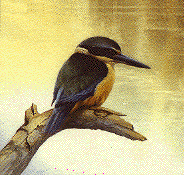 Each of us quite naturally perceives ourself to be at the center of things,
but no one would deny that other events ultimately have their influence, too.
Likewise, many people unconsciously place humanity at the exact center of the
universe. In this view, the utility of anything is measured by how it can be
used by humans. For many, everything has its dollar value. Such anthropocentrism
is understandable, but narrow and misguided.
Each of us quite naturally perceives ourself to be at the center of things,
but no one would deny that other events ultimately have their influence, too.
Likewise, many people unconsciously place humanity at the exact center of the
universe. In this view, the utility of anything is measured by how it can be
used by humans. For many, everything has its dollar value. Such anthropocentrism
is understandable, but narrow and misguided.
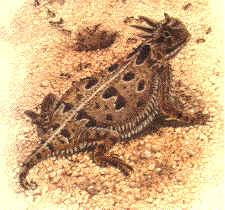
It is a worthwhile exercise to imagine that something else, such as an ant, a lizard, an oak tree, or an HIV virus, is really the focus of the cosmos. From such a perspective, the almighty dollar quickly loses its primacy. Survival (Survival Kit) and reproduction assume a lot more significance. What good are lizards? Indeed, what good are you?!  Why should I take this course?
Eric R. Pianka
erp@austin.utexas.edu, Patterson 125 (471-7472),
Office: Patterson 125 -- Mondays and Fridays 1-2 PM (or by appointment)
Lectures: Tuesday and Thursday, 11AM-1230 PM (Welch 2.122)
David Ledesma Ledesma@utexas.edu, AM Discussion Sections
Office: Patterson 122 -- make appointment by email. Wednesday 8-9 AM RLP 0.122
Wednesday 9-10 AM RLP 0.122
Wednesday 10-11 AM GDC 2.502
Wednesday 11-12 AM GDC 2.502
Kyle Wilhite kwilhite@utexas.edu, PM Discussion Sections
Office: Patterson 113 -- make appointment by email.
Wednesday 1-2 PM GEA 127
Wednesday 2-3 PM GEA 127
Wednesday 3-4 PM RLM 5.126
Wednesday 4-5 PM RLM 5.126 Why should I take this course?
Eric R. Pianka
erp@austin.utexas.edu, Patterson 125 (471-7472),
Office: Patterson 125 -- Mondays and Fridays 1-2 PM (or by appointment)
Lectures: Tuesday and Thursday, 11AM-1230 PM (Welch 2.122)
David Ledesma Ledesma@utexas.edu, AM Discussion Sections
Office: Patterson 122 -- make appointment by email. Wednesday 8-9 AM RLP 0.122
Wednesday 9-10 AM RLP 0.122
Wednesday 10-11 AM GDC 2.502
Wednesday 11-12 AM GDC 2.502
Kyle Wilhite kwilhite@utexas.edu, PM Discussion Sections
Office: Patterson 113 -- make appointment by email.
Wednesday 1-2 PM GEA 127
Wednesday 2-3 PM GEA 127
Wednesday 3-4 PM RLM 5.126
Wednesday 4-5 PM RLM 5.126
This course assumes knowledge of High School algebra, geometry, and genetics. You will be expected to be able to understand 3-dimensional graphs and be able to manipulate simple equations. Philosophy: We will attempt to teach you the basic ecology and evolution that everyone should know to become better informed citizens of this, our one and only planet, Spaceship Earth -- we will also do our utmost to encourage you to think. Here are links to some of the things we'll cover in discussion sections: You are expected to read all 27 of these. The first nine will be covered on the first exam, the second eight on the second exam and the remaining ten will be covered on the third exam. All 27 will be included on the final exam. Please read "Scientific Methods" as soon as you can, as we will cover this in early discussions and lectures. Epidemiology
Scientific Methods
Natural Selection
On Human Nature
Our Hunter-Gatherer Heritage
Evolution of Uncaring Humanoids
Global Warming
Population Growth
Evolution's Problem Gamblers
(Download printable version of Evolution's Problem Gamblers)
Agriculture
Unburnable Oil
The Vanishing Book of Life on Earth
Horse Power
The Weakest Link
Technology
Economics
Intelligent Design?
Energy
Money
Corporations
Land
Water
Food
Sewage
Plastics
Solutions
Space Travel
Watch these videos: Cosmos "Evolution" movie (50 seconds)
NASA's "Average Temperatures 1884-2012" (45 seconds)
Ernest Kline's Dance, Monkeys, Dance (3.5 minutes)
Link: "The Monkey Trap"
ERP's Domino Effects (6.5 minutes)
New York Times Link: Antarctic Ice Melts
New York Times Link: Galapagos Climate Change
New York Times Link: Easter Island Rising Sea Levels
Download Syllabus: This constitutes a contract between each student, me, and UT 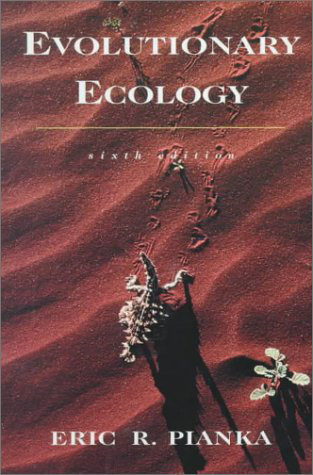 Text:
Text:
Pianka, Evolutionary Ecology, 6th or 7th ed.  Sixth Edition out of print but available
Seventh Edition - eBook available from
Google
Read On Line at
Canvas
(use Safari)
(other browsers may not work):Course Documents
Sixth Edition out of print but available
Seventh Edition - eBook available from
Google
Read On Line at
Canvas
(use Safari)
(other browsers may not work):Course Documents
Chapter 1 - Background Chapter 2 - Classical Biogeography Chapter 3 - Meteorology Chapter 4 - Climate and Vegetation Chapter 5 - Resource Acquisition and Allocation Chapter 6 - Rules of Inheritance Chapter 7 - Evolution and Natural Selection Chapter 8 - Vital Statistics of Populations Chapter 9 - Population Growth and Regulation Chapter 10 - Sociality Chapter 11 - Interactions Between Populations Chapter 12 - Competition Chapter 13 - The Ecological Niche Chapter 14 - Experimental Ecology Chapter 15 - Predation and Parasitism Chapter 16 - Phylogenetics in Ecology Chapter 17 - Community and Ecosystem Ecology Chapter 18 - Biodiversity and Community Stability Chapter 19 - Island Biogeography and Conservation Biology Ecopoetry 1: Kurt Vonnegut's "Requiem" (68 seconds)
Ecopoetry 2: James Dickey's "For the Last Wolverine" (6 minutes)
Grading and Grades: 
Hour Exams: Thursday, 20 February
Thursday, 2 April
Thursday, 7 May
Final Exam: Wednesday, May 13, 2-5 pmDownload Sample First Exam
Download Sample Second Exam
Download Sample Third Exam
Best 2 of the above 3 hour exams will count 20% each (40% total), your performance on problems and attendance and assignments in discussion sections will count for an additional 20%. The comprehensive final exam makes up the other 40% of your letter grade. These four exams and your performance in discussion sections are your only opportunities to earn your letter grade. UT's "new" plus/minus grading system will be employed. No "extra" points are available. Your lowest hour exam will be dropped, so you can miss ONE exam (for which you'll be scored a zero). You will be expected to "know" everything the instructors say in lecture and discussion sections, including pauses and nuances, as well as everything assigned in reading assignments. Exams will be in multiple choice format. Each hour exam will cover about one-third of the class. Everyone must take at least two of the three hour exams plus the comprehensive 3 hour final exam. No "Make Up" exams will be given. Final Grades are final, carved in stone, and non-negotiable (please don't even bother to question them!). They are a measure of your own phenotype, and not our reponsibility. We expect you to accept your own performance as an integral part of yourself. Videotapes of Lectures __________________________________________________________________ This class uses the Lectures Online recording system. This system records the audio and video material presented in class for you to review after class. Links for the recordings will appear in the Lectures Online tab on the Canvas page for this class. You will find this tab along the left side navigation in Canvas.
To review a recording, simply click on the Lectures Online navigation tab and follow the instructions presented to you on that page.
How to get straight A's Class Lecture notes
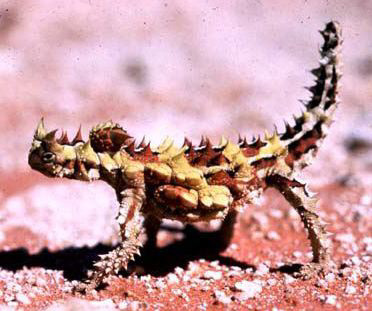 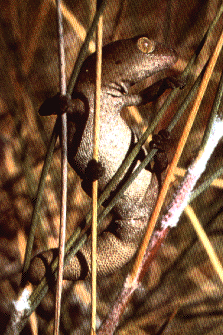
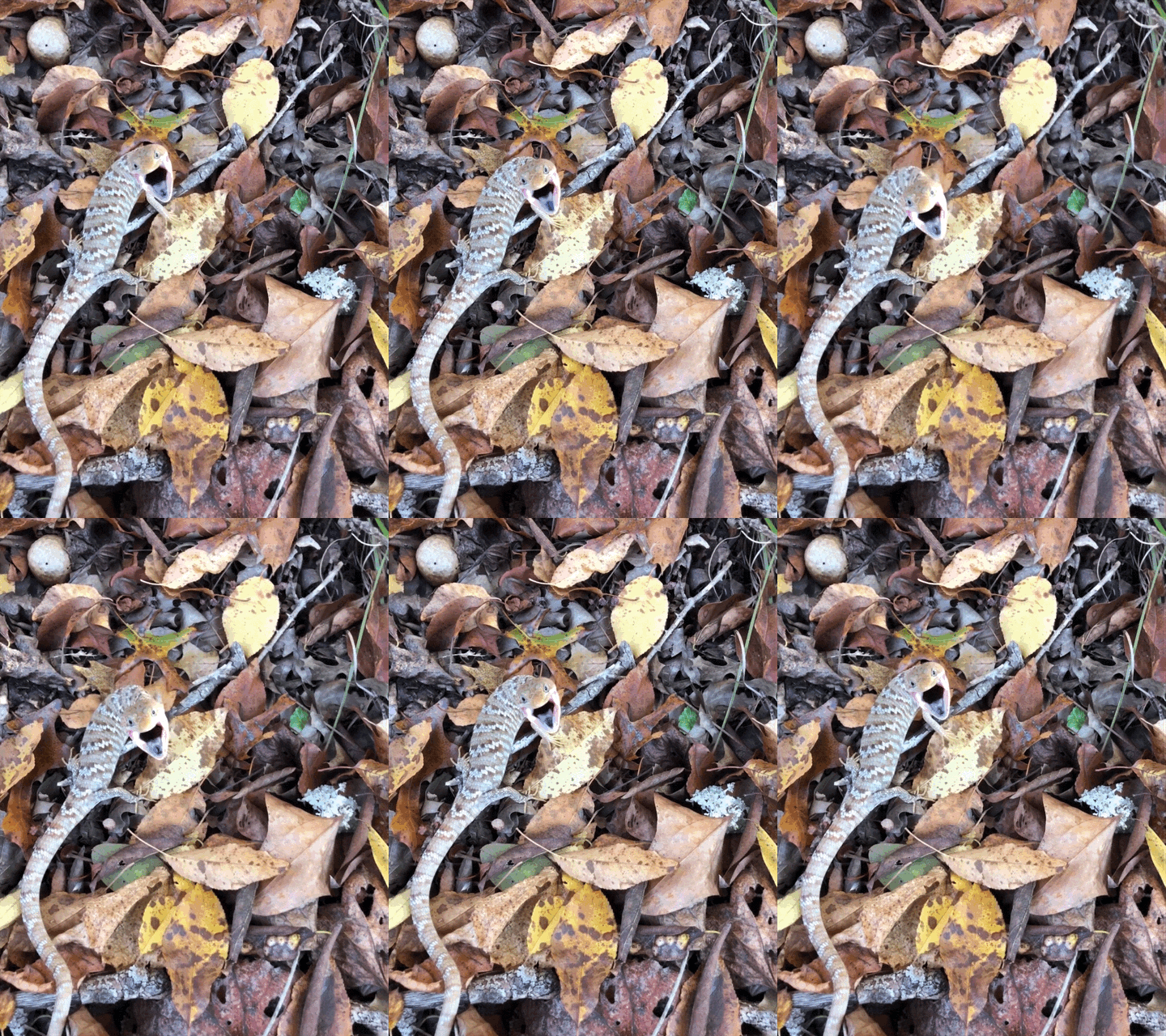
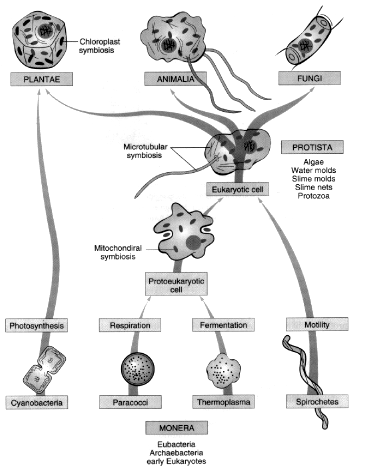
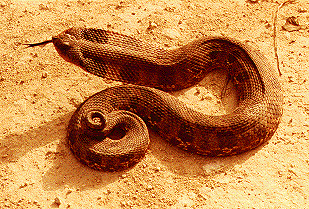 A Texas Alligator lizard Gerrhonotus threat display. Australian Strophurus gecko defensive posture. Outline of Subjects to be covered in the Course Biology 301M - Ecology, Evolution, and Society Professor Eric R. Pianka Definitions and Groundwork, anthropocentrism, the importance of wild organisms in pristine natural environments, the urgency of basic ecological research, Scaling and the hierarchical structure of biology, levels of approach in biology, domain of ecology, the scientific method, models, multiple causality, environment, nature versus nurture, limiting factors, tolerance limits, the principle of allocation, genetics, natural selection, self-replicating molecular assemblages, units of selection, levels of selection, speciation, phylogeny, classification and systematics. 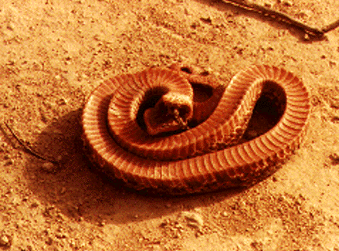 Macroevolution, natural selection and adaptation, the species concept. Origin of life, prokaryotes and eukaryotes, introduction to the diversity of organisms. Domains, traits (and example organisms) of kingdoms [archaebacteria, eubacteria, protists, fungi, plants, animals] Adaptations, structures, symbiotic relationships, including variations in life cycles How organisms are classified and why, phylogenetic systematics. One major taxon will be examined in depth (Lizards), we will investigate classification, phylogeny, and biogeography. Evolution will be related to the history of earth History and Biogeography Self-replicating molecular assemblages, geological past, classical biogeography, plate tectonics and continental drift Meteorology Major determinants of climate, local perturbations, variations in time and space, global weather modification Climate and Vegetation Plant life forms and biomes, microclimate, primary production and evapotranspiration, soil formation and primary succession, ecotones, classification of natural communities, aquatic ecosystems Physiological Ecology Physiological optima and tolerance curves, energetics of metabolism and movement, energy budgets and the principle of allocation, adaptation and deterioration of environment, heat budgets and thermal ecology, water economy in desert organisms, other limiting materials, sensory capacties and environmental cues, adaptive suites and design constraints. 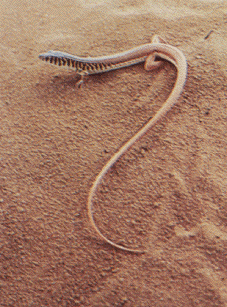 Principles of Population Ecology
Life tables and schedules of reproduction, net reproductive rate and reproductive value, stable age distribution, intrinsic rate of increase, population growth and regulation, Pearl-Verhulst logistic equation, density dependence and independence, r and K selection, population "cycles," cause and effect, metapopulations, evolution of reproductive tactics, evolution of old age and death rates, use of space, evolution of sex, sex ratio, mating systems, sexual selection, fitness and the individual's status in the population, kin selection, reciprocal altruism, parent-offspring conflict and group selection, game theory and evolutionary stable strategies. Interactions Between Populations Complex examples of population interactions, indirect interactions, competition theory, competitive exclusion, balance between intraspecific and interspecific competition, evolutionary consequences of competition, laboratory experiments and evidence from nature, character displacement and limiting similarity, future prospects, Predation, predator-prey oscillations, "prudent" predation and optimal yield, theory of predation, functional and numerical responses, selected experiments and observations, evolutionary consequences of predation: predator escape tactics, aspect diversity and escape tactic diversity, coevolution, plant apparency theory, evolution of pollination mechanisms, symbiotic relationships. The Role of Phylogenetics in Ecology Phylogenetic systematics, independent contrasts, the comparative method, evolutionary ecomorphology, ecological equivalents and convergent evolution. Community Ecology Classification of communities, interface between climate and vegetation, plant life forms and biomes, leaf tactics, succession, transition matrices, aquatic systems, community organization, trophic levels and food webs, the community matrix, guild structure, primary productivity and evapotranspiration, pyramids of numbers, biomass, and energy, energy flow and ecological energetics, saturation with individuals and with species, species diversity, diversity of lowland rainforest trees, community stability, evolutionary convergence and ecological equivalents, ecotones, vegetational continuua, soil formation and primary succession, evolution of communities. Island Biogeography and Conservation Biology Classical biogeography, biogeographic "rules," continental drift, island biogeography, species-area relationships, equilibrium theory, compression hypothesis, islands as ecological experiments: Krakatau, Darwin's finches, and other examples, metapopulations, conservation biology, human impacts on natural ecosystems, hot spots of biodiversity, applied biogeography and the design of nature preserves. To go to Pianka Lab Homepage Last updated 15 January 2020 by Eric R. Pianka |